|
Lamedh
|
|---|
 | |
ל
| |
 | |
ܠ
| |
ل,ل
|
|
| Phonemic representation | l, ɫ |
|---|
| Position in alphabet | 12 |
|---|
| Numerical value | 30 |
|---|
| Alphabetic derivatives of the Phoenician |
|---|
|
|
Hebrew Lamed[edit]
Hebrew spelling: לָמֶד
Pronunciation[edit]
Significance[edit]
Lamed in
gematria represents the number 30.
With the letter
Vav it refers to the
Lamedvavniks, the 36 righteous people who save the world from destruction.
As an abbreviation, it can stand for litre. Also, a sign on a car with a Lamed on it means that the driver is a student of driving (the Lamed stands for lomed, learner).
As a prefix, it can have two purposes:
- It can be attached to verb roots, designating the infinitive (Daber means "speak", Ledaber means to speak).
- It can also act as a preposition meaning "to" or "for".
Arabic lām[edit]
The letter is named lām, and is written is several ways depending in its position in the word:
| Position in word: | Isolated | Final | Medial | Initial |
|---|
| Glyph form: | ل | ـل | ـلـ | لـ |
|---|
Lām is used as a prefix in two different ways. Lām-kasra (لـِ,
/li/) is essentially a
preposition meaning "to" or "for", as in لِوالدي
liwālidī, "for my father". In this usage, it has become concatenated with other words to form new constructions often treated as independent words: for instance, لِماذا
limāḏā, meaning "why?", is derived from لـِ li and ماذا
māḏā, meaning "what?" thus getting "for what?". This construction is virtually semantically identical the equivalent in most
Romance languages, e.g.
French pourquoi,
Spanish por qué, and
Italian perché (though
ché is an archaism and not in current use).
The
goad is a
traditional farming implement, used to spur or guide lifestock, usually
oxen, which are pulling a
plough or a
cart; used also to round up cattle. It is a type of long stick with a pointed end, also known as the
cattle prod. Though many people are unfamiliar with them today, goads have been common throughout the world. Goads in various guises are
iconographic devices and may be seen in the 'elephant goad' or '
ankusha' (Sanskrit) in the hand of
Ganesha, for example.
Tischler and McHenry (2006: p. 251) in discussing the biblical account of 'goad' hold:
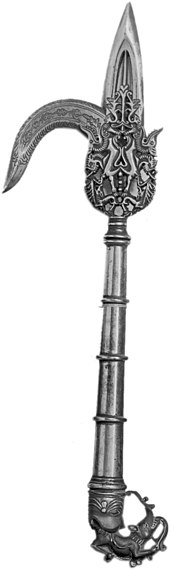
17th century Ankusha from South India.
The
elephant goad,
bullhook, or
ankus (from Sanskrit
aṅkuśa or
ankusha) is a tool employed in the
handling and training of elephants.
[1] It consists of a hook (usually bronze or steel) which is attached to a 60 – 90 cm (two- or three-foot) handle, ending in a tapered end.
[2][3][4][5]The cities of
Los Angeles and
Oakland, California, USA, have banned the use of bullhooks.
[6]
A relief at
Sanchi and a fresco at the
Ajanta Caves depict a three-person crew on the war elephant, the driver with an elephant goad, what appears to be a noble warrior behind the driver and another attendant on the posterior of the elephant.
[7] Nossov and Dennis (2008 p 19) report that two perfectly preserved elephant goads were recovered from an archaeological site at
Taxila and are dated from 3rd century BCE to the 1st century CE according to
Marshall. The larger of the two is 65 cm long.
[7]
Nossov and Dennis (2008: p. 16) state:
An
ankusha, a sharpened goad with a pointed hook, was the main tool for managing an elephant. The
ankusha first appeared in India in the 6th-5th century BC and has been used ever since, not only there, but wherever elephants served man.
[8]
Fabrication and construction[edit]
The handle can be made of any material, from wood to ivory, depending on the wealth and opulence of the owner. Contemporary bullhooks which are used for animal handling generally have handles made of fibreglass, metal, plastic, or wood.
The elephant goad is found in armouries and temples all across
India, where elephants march in religious processions and perform in various civil capacities. They are often quite ornate, being decorated with gemstones and engravings to be appropriate for the ceremonies in which they are used.
Iconography[edit]

The
Hindu god
Ganesha holding an elephant goad in his right upper arm
The elephant has appeared in cultures across the world. They are a symbol of wisdom in Asian cultures and are famed for their memory and intelligence, where they are thought to be on par with
cetaceans[9] and
hominids.
[10] Aristotle once said the elephant was "the beast which passeth all others in wit and mind".
[11]The word "elephant" has its origins in the Greek
ἐλέφας, meaning "ivory" or "elephant".
[12]
In iconography and ceremonial ritual tools, the elephant goad is often included in a hybridized tool, for example one that includes elements of
Vajrakila, 'hooked knife' or 'skin flail' (Tibetan: gri-gug, Sanskrit: kartika),
Vajra and Axe, as well as the goad functionality for example. Ritual Ankusha were often finely wrought of precious metals and even fabricated from
ivory, often encrusted with jewels. In Dharmic Traditions the goad/ankusha and rope 'noose/snare/lasso' (Sanskrit: Pāśa) are traditionally paired as tools of subjugation.
[13]
Hinduism[edit]
In the Hinduism, an elephant goad is one of the eight auspicious objects known as
Astamangala and certain other religions of the
Indian subcontinent. A goad is also an attribute of many Hindu gods, including
Ganesha.


 , but this is presumably an independent development, by modification of the


